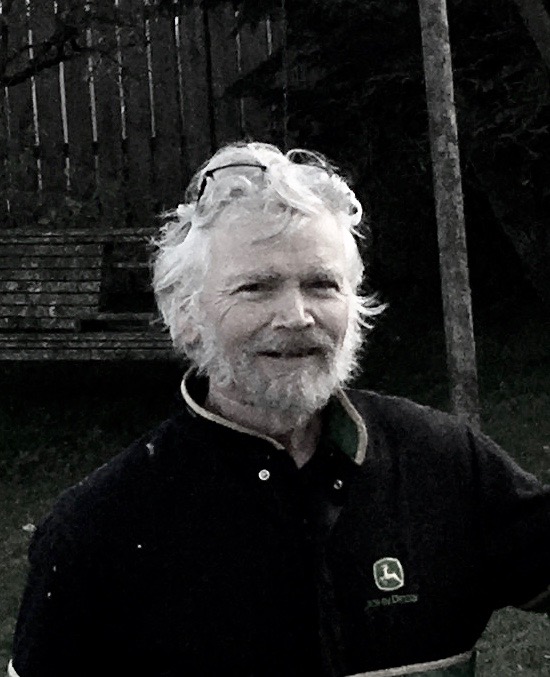
For whatever reason, I’ve been identified locally as the guy who loves to fix things. Or let’s say rather, who loves to see things working correctly. I don’t mind work-arounds, not at all, but if the end result is that the thing is working and performing the function for which it was intended, I’m a happy guy.
The clock in the New Galloway Town Hall, the one with four faces to the four winds, now all illuminated during the darker hours, has had an issue, ever since the renovation work began, and maybe even before: it had ceased to strike the hours. The big bell that’s connected to the clock mechanism has a lovely, sonorous bong, and the clock rings the hour by hitting it on the outside with a large hammer.
But it’s not merely mechanical any longer, oh no. It’s all controlled electrically, and there are two separate mechanisms: one for the clock itself, and another for the bongs. Indeed, there are really two separate clocks, and if the clock that drives the four faces gets too slow, or too fast, it will be out of synch with the controller that drives the motor which activates the long wire leveraged up to the belfry and the hammer. When it’s too far out of synch, the controller refuses to accept the simple signal from the actual clock and so the clock will no longer bong until it’s reset to tell the correct time.
So far so safe. But the bong controller had given up the ghost, and repair of its electronics was only the beginning of a multifactorial adventure upon which I was to embark. The controller had come back from the clock repairers in Edinburgh; who would connect it back again? I was asked, but I was afraid, until it turned out that so was everyone else, and I was probably the most foolhardy. So up I went, with the able assistance and problem-solving mind of our neighbour Julian, and we scratched our heads at the connection challenge.
Three cables confronted us, two of which had prepared tails on the live, neutral and earth wires, the other of which had been snippped off clean. Which ones were to go where? The letter from the repairer was cryptic, indicating connections from the clock assembly switch, and the bell motor assembly switch, but not where they should go. We were lucky to get some dis-assembly photographs, thanks to Julian’s perseverance on the mobile, and we tried to parse things together, and finally we set it all off to see what would happen. Nothing, as it turned out, but at least the clock still worked — we hadn’t wrecked everything. Still no bongs.
Julian had also, presciently, got the number of the clock repair place from the dis-assembler, and we got straight through to Lloyd, who was precisely the right person to guide us through the process of re-connection. It turned out that we had indeed wired it in correctly, but apparently the clock was not communicating with the controller; was it the switch, or the program? That’s where the fun really started.
It seemed, since we’re two hours from Edinburgh, that the best thing for it was for me to chat with Lloyd on the phone while I tried to be his hands. Julian had other caretaker duties to deal with, so I stayed up in the tower. We worked together, Lloyd and me, over the next two days, eking incremental advances on the issues at hand: (i) The switch connection was solid, and we could test bong the big bell through the controller; (ii) We could not make a connection, however, on the hour, between the clock and the controller. (iii) Manual flipping of the switch on the clock assembly elicited a reaction from the controller, but only if flipped ‘on the hour,’ to elicit the appropriate bongs at 12 noon. This was a major advance, as previous attempts on the switch had yielded no response.
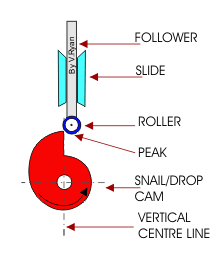
We returned to my observation that the snail cam that drove the switch, attached to the clock assembly, was dropping that switch 10 minutes prior to the appropriate time as shown on the clock faces. Was this drop possibly too early to catch the available window for the controller to receive? We set the controller to 10 minutes ahead of time, so it would be ready for the cam drop-out, and waited.
At 2:50pm yesterday, the strike mechanism swung into action, responding to the cam drop, and the clock struck three times.
This had been a long run with Lloyd to a short slide, but the joy that I felt as the clock struck ‘all by itself,’ independently of any external manipulation, is something that I am having some difficulty adequately describing.
But every bong of that clock, especially as we work towards achieving synchronicity between the analogue hands on the hour and the bongs (by some careful calibration of that cam motion, perhaps), is going to elicit a resonant chime within this beating heart.
Welcome to Christmas, courtesy of the electro-mechanical angels!

 Roads to Joy
Leave a comment